Cassidy Blumtickle’s Field Guide to Creatures of Airnea and Known Threats to Plumbers
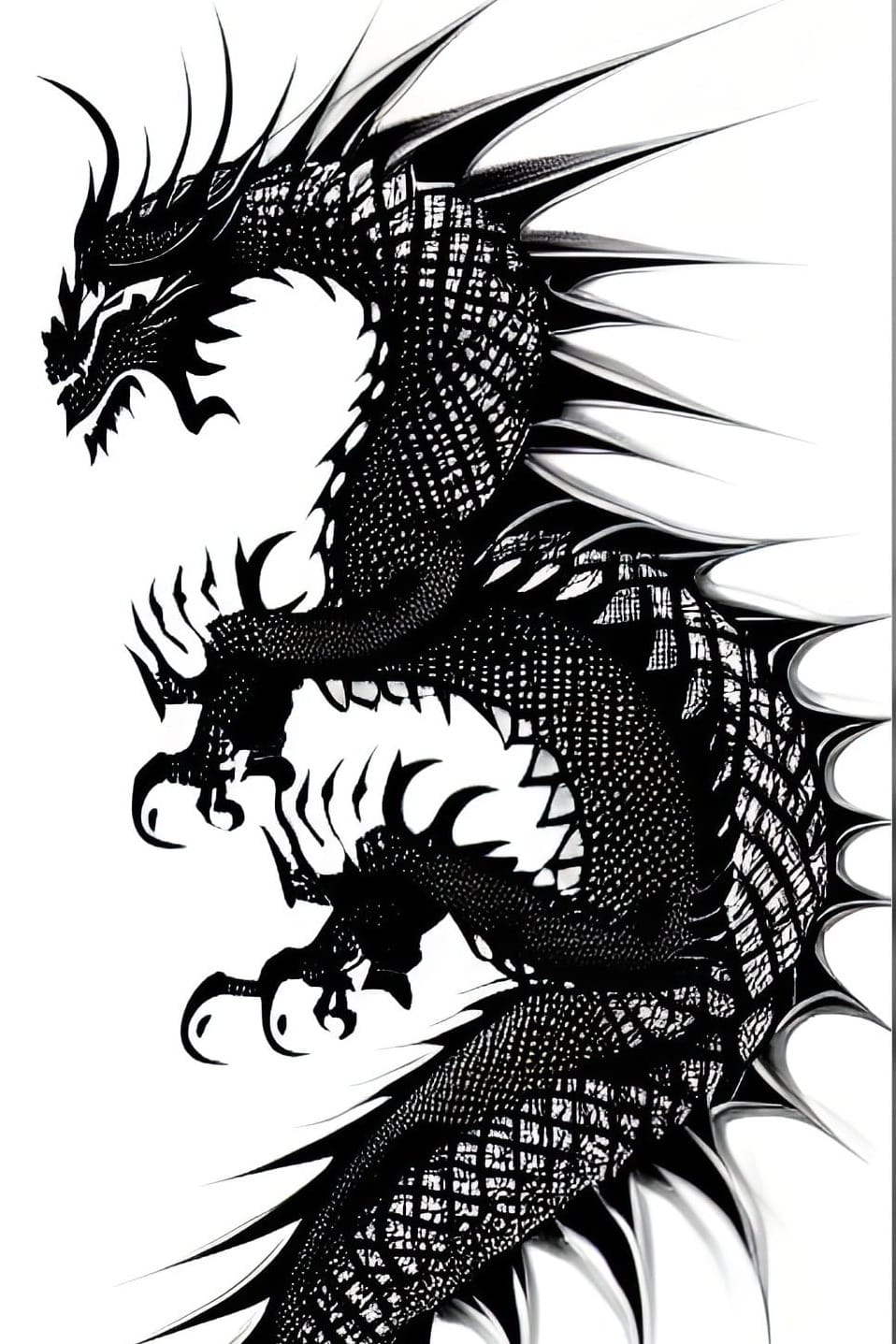
Non Threatening or Domesticable Creatures
Brutox - It resembles a bull/rhino/zebra, and is a commonly found pack animal in Airnea, Ranched for its milk and beef, even outfitted for battle with its large singular horn protruding from its snout. The horns of dead brutox are often used for drinking flagons or for pipes, from whence the term “Hornsmoker” originates.
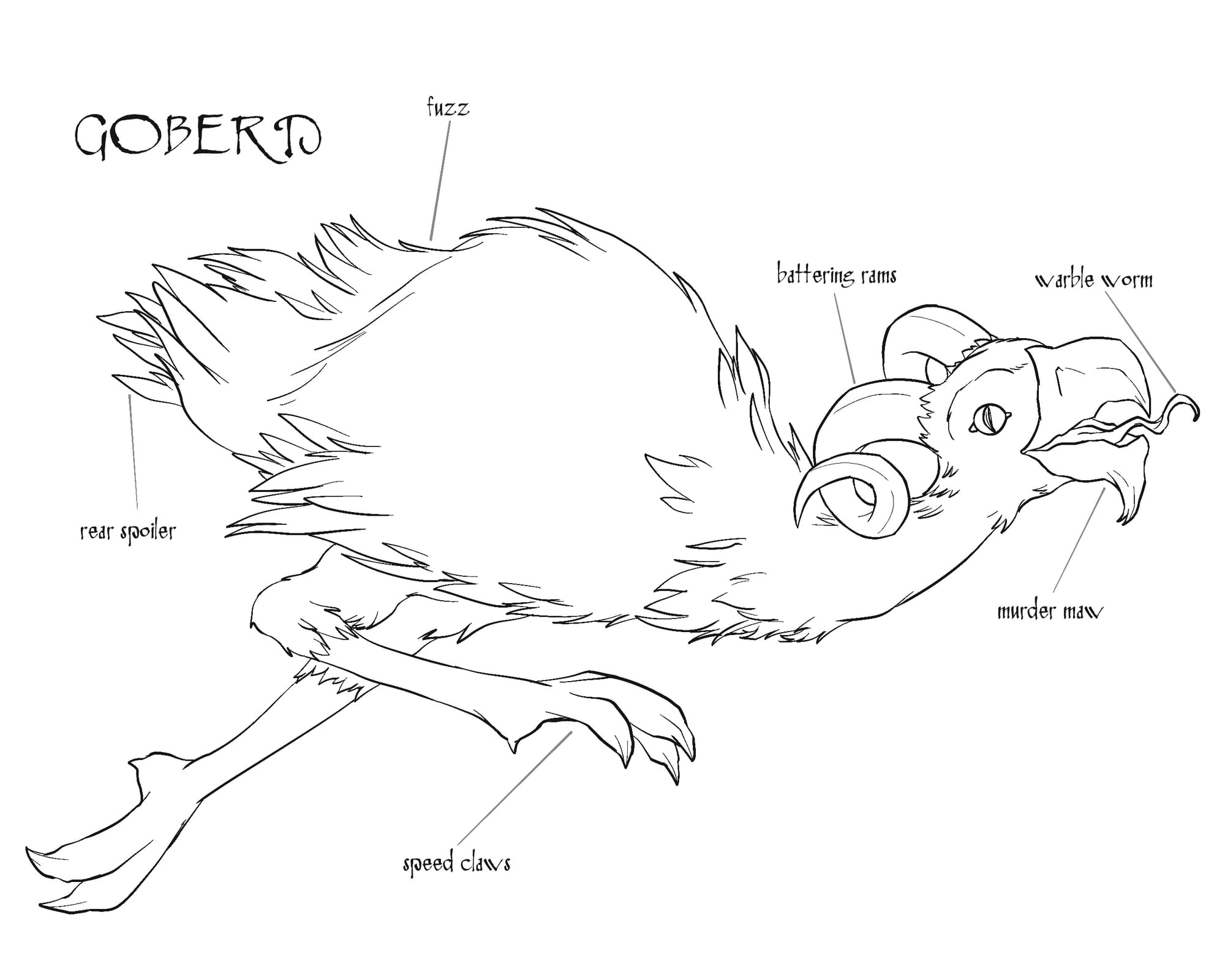
The Goberd, or sometimes pronounced “gobert”, “gibird”, or “gbrt”, is a flightless hairy bird with horns, about as tall as a man, with powerful legs, able to bear a modest load or pull a cart, and has a penchant for eating anything, often snails and slugs, sometimes munching on tin cans with its short beak. It’s cry is a warbling “mahhh!” like a billy goat, whatever that is, with its long tongue waggling about. You can ride them like an Ostrix, but they do not like it, and only will do it with the best of animal handling. They are placed in long trains to pull caravans, sometimes as many as 50, to assist the Brute Ox train, but mainly are there for protection, in the case of attack by daghorns or even larger beasts. If a caravan is attacked and the guards are unable to repel the predators, the Goberds will be released in a last ditch effort to draw the predators away from the caravan. On such trips the goberds are lovingly called “the lambs”.
Ostrix - Depending on where you are from, these large flightless birds are a common steed. They are well suited for training, can also be harnessed as a pack animal, they consist mostly on grubs and truffles, but also love fish. They have beaks that vary from wide like a shoebill to curved like a parrot, and have a wide range of colors and breeds. They will also graze when nothing else is available, and can sustain long periods without water, making them highly valued in the Desert..
Thornbacks - a cross between a boar and a porcupine, They are the wild variant of the furhogs and burrowhogs that are often farmed. Without tusks, they have spikes running down their spine and tail, ranging from thick to needle thin depending on where they are found. Their meat is delectable, particularly when smoked.
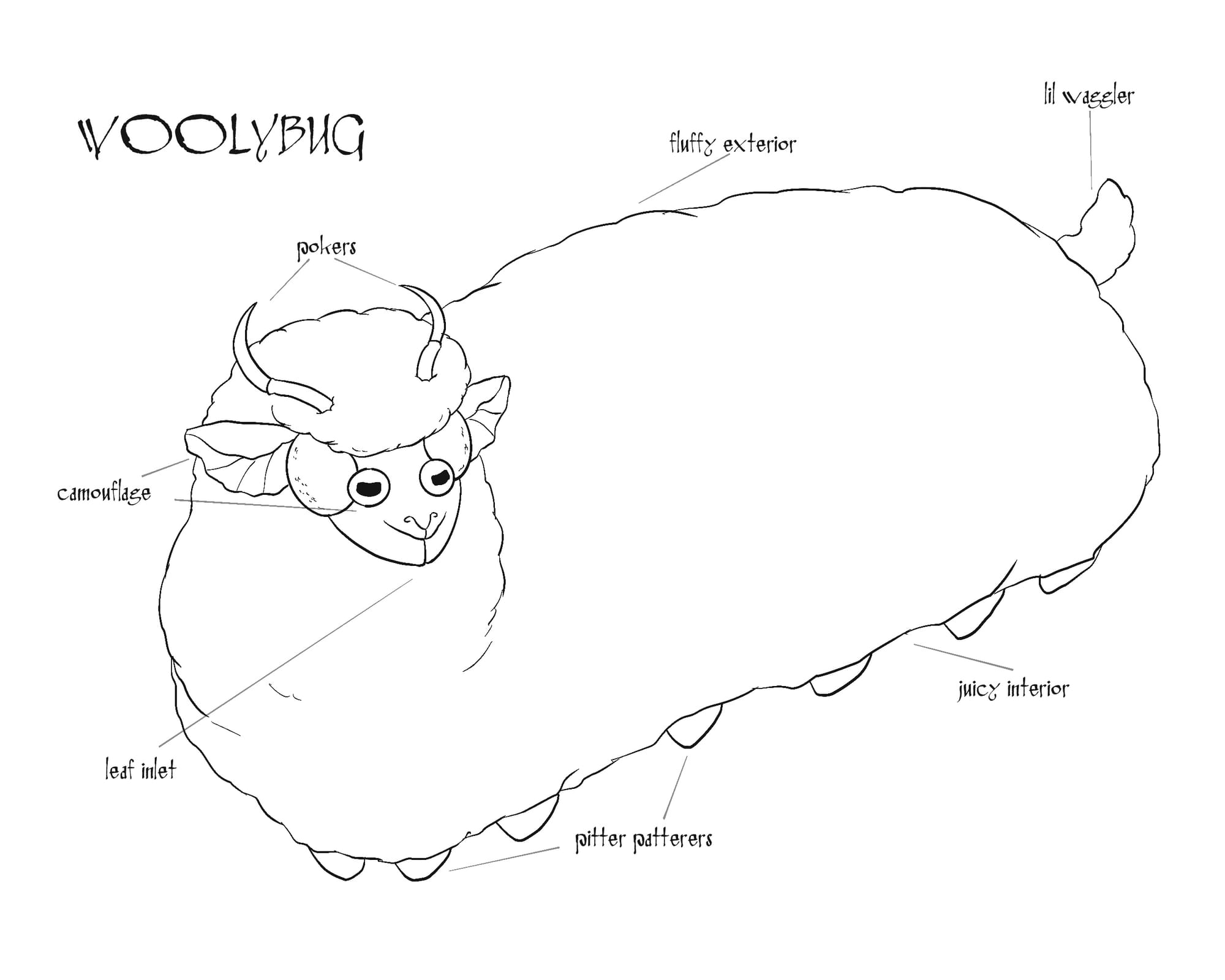
Woolybugs are the most commonly farmed creature throughout the Known Worlds. They survive on green plants, grass, leaves, etc. If it’s green and planty, they eat it. They are also quite docile, as they have no real natural defenses save their tiny horns. They resemble a sheep and a catapillar, some growing quite long, and many little hoofed feet underneath their wooly carapace. The wool can be harvested year after year for trade, keeping many a mountaineer warm at night. Woolybug wool is second only to Cotton, but more manageable as cotton plants are so large and only a few plants can be grown on a given acre. Their meat is fatty and succulent, and you can slice it quite easily into very large steaks, but never serve the butt of a Woolybug, that’s where the poop comes out.
Bumblejay or Honeybirds - these are a large insect that resembles a bird, and are farmed for honey. Like a fat fuzzy hummingbird. They do produce honey, but the birds are very protective of their hives, and farming them has been a difficult undertaking. Honey is therefore prohibitively expensive as a sweetener.
Salamanders or Axolotl are large aquatic creatures, growing up to 15 feet long, and are largely docile, but can be dangerous when threatened, and can attack with their hind claws and tongue. They are often farmed for their eggs, which are a delicacy. They are also commonly employed by plumbers to help cleaning out waterworks.
Turtlecocks or cluckers - these are also raised for their eggs and meat, they are a duck-turtle that can survive on both land and in the water.
Frogboar are found in swamps, and are quite dangerous when full grown. These horned and tusked frogs will ram each other like mountain goats when competing for a mate, and will also ram a trespasser in their territory. Also farmed for food in some swamp areas.
Dualpaca are the most common herd animal for their wool, which also comes in a broad array of colors, and they almost always have two heads sometimes three.
A Willowpede - a many legged insect that resembles a flowering branch. They are quite exquisite to look at and are often featured prominently in gardens. They tend to protect plants from other insects, and are quite curious.
Numfers are sugar-glider rabbits who live in trees and eat leafy greens, fruits and flowers. Instead of hopping, they swing and glide from branch to branch with their six limbs. Their large ears are great for echolocation and are nocturnal. They make fun pets. They are often farmed for their drumsticks.
Weselpiders are a many legged weasel or ferret, who are very curious. They are equal to cats at keeping pests away, and will grow up to 10 sets of feet. They will eat just about anything.
Popshrooms - it is unclear as to whether it’s a plant or an animal, but this mushroom tends to get around by hopping, and will find the shadiest spots in the forest. These are often kept by Myconids and Redcaps as pets.
Quervil - tree rodent with a fan tale, to make itself look bigger. Can often be mistaken for a tiger or fox face when its tail is fanned and will make a low growly sound. Live on nuts mostly, which it collects for the winter. Has very smelly farts, so you can smell them when they are around. Does 2d6 smelly damage, and that's the number of days you stink like Quervil. People who smell bad in general are referred to as Quervils derisively.
Rubber Beavers live in the tropical forests of Fazeel and feed off the rubber trees in the jungle, from which they build their homes and dams. They are prone to bounce.
Flutterprawn are a species of winged shrimp which feed on windborn plant material. They form large sparkling murmurations about wind currents coming offland. They are in turn consumed by Skywhales.
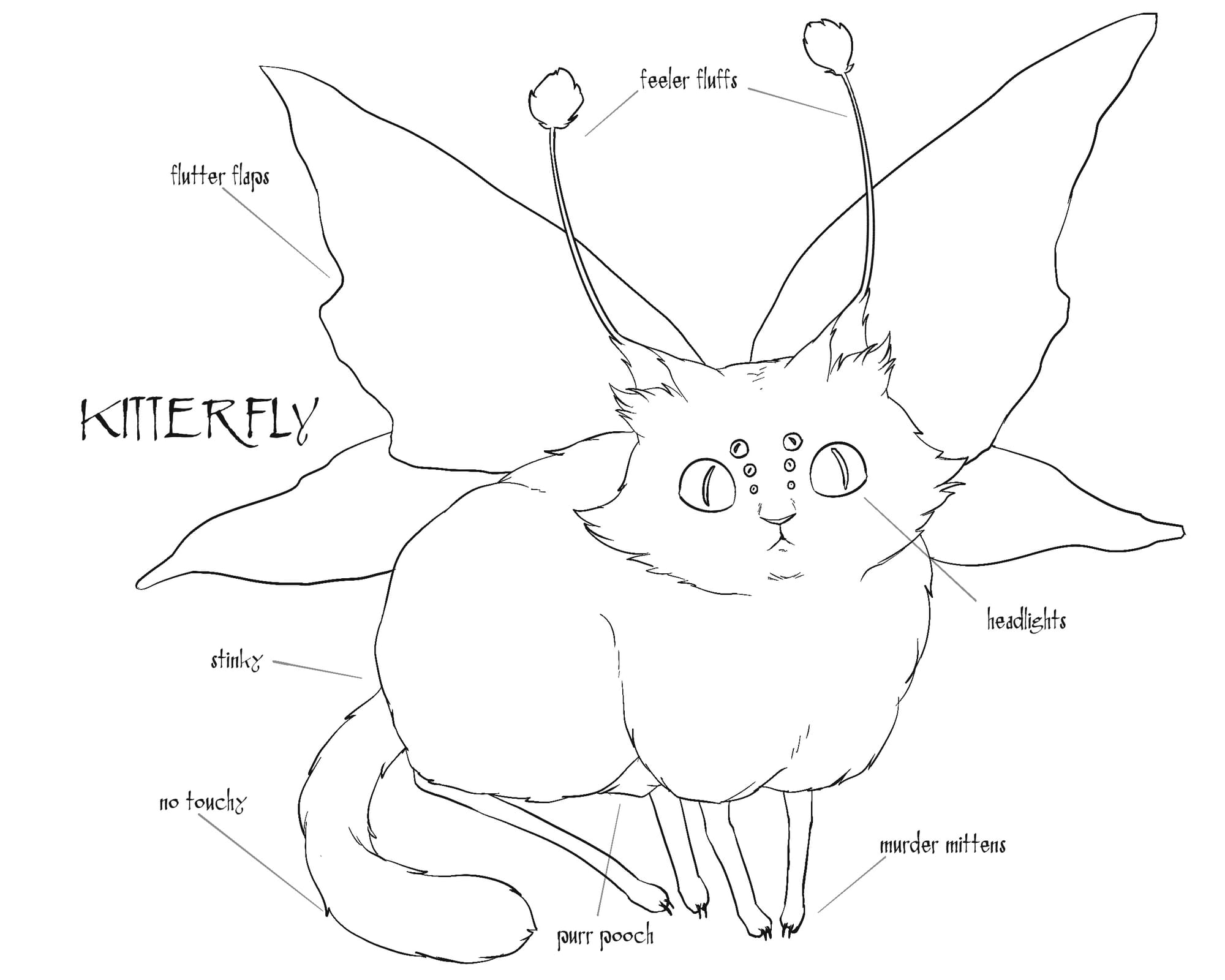
A Kitterfly is a very small colorful cat, no bigger than your hand, with butterfly wings. It has very small paws with long hind limbs, and wisps of hair like antennae that sprout from the tips of their ears. They have two large eyes, and then a line of smaller eyes down each side of the bridge of the nose, which are less noticeable. They prey on other small insects and beetles, and are often kept as pets by jungle denizens. They also have the ability to warn of a Fihrblix by hissing in its direction. Kitterfly’s are also a choice meal of the Fihrblix. Kitterflies colors are of a near infinite variety.
Wormkin are tiny caterpillar creatures with large eyes and a small mouth that can speak to people. They often have a mop of hair on their heads and will lift their head and front legs when speaking. Quite friendly, and offer advice on all sorts of subjects, not always good however.
Sunflies are large brightly colored bugs with long iridescent wings. They are harmless and beautiful, and buzz harmoniously.
Muskaroos will remind one of a deer and a kangaroo all at once. They wander in herds and munch on flora of all sorts, and are hunted for meat and leather hides. They are hard to chase down, due to their swift hopping.
Bubblefish float around the skys in schools, storing gasses in their gullets to give them round shapes with very small fins that flap. They can deploy spikes as a defense, so airships beware. Other than that they are quite harmless, and if caught they will deflate, and are a small, meager meal.
Plaidiper, the fly catcher, resembles a spindly spider wearing a plaid shirt and long argyle socks on each of its eight legs. They will set up in the corners of homes, and are a sign of good luck. Unlike their Gargantula cousins, they are friendly. They communicate by weaving words into their webs, often making jokes for their housemates. Their venom is only effective against pests, and does not bite humans. They will peacock sometimes when they see another Plaidiper. Their webs are generally square and quite colorful and neat, unlike their cousins the Paisleypiders who make more psychedelic designs in their webs and will often exclaim “groovy” or “dude” when a fly gets trapped or something exciting happens. Paisleypiders also have larger flared collars.
A Dinglewomp is cousin of the Nohmish who never grew out of the Brownie stage. They resemble a very tiny old man, small enough to hold in your hand, clad only in a bushy beard down to his knees. Some are bald, some have wild hair, all are rather dirty. They do not speak except for an occasional mumble or shriek. They don’t like cats or snakes. They are curious and mischievous, often ringing bells or knocking things over. They tend to be hermits living in a hole in the wall, and when given a bit of chalk or charcoal they will scribble runes. The only ones they seem to converse with are Wormkin.
Quixies are cousins of the Nohmish who have never grown out of the Fairy stage. They resemble a very tiny girl with long iridescent wings, and long flowing hair down to their knees. They fly about pollinating flowers, tending gardens, singing in high buzzing voices, and causing mischief. Don’t try and catch a Quixie, they will bite. They have no magical properties, unlike their Pixie and Nixie cousins, who do talk and cast spells. They fart pixie dust as an accelerator to make a quick getaway.
Nerdilus is a crab who makes a spiral shell with propellers on the sides and flies about collecting things. It’s shell is a pocket dimension which they store, catalog, display, and muse over their collections. They are quite wise, and if you gain their trust, you can hold the shell up to one ear, and they will whisper secrets of the wide world to you. If they don’t trust you, they will pinch your ear with their claw and fly off before you can say Jack Daniels. Most are far sighted and need spectacles to examine their findings.
Crabestrians are crustaceans who hitch rides on air ships or flying creatures from one continent to another. They feed off of whatever they can get their claws on, and are known to wear hats on occasion, toast drinks, and chitter to each other about the cuisine.
Newts, house lizards, who like the damp areas of the cellar, and keep away pests. You may see a Dinglewomp riding them occasionally. Newts know the secret cracks in the world, and each one is unique in coloration. They can often deliver a message from the lands of the deep to the surface and vice versa, if you give them a treat. They particularly like Sunflies.
Vapor Cats are descendants of Liquid Cats and have evolved to the next stage where they can not only inhabit whatever vessel they nestle in, but can make their way through keyholes, door cracks, and other impossibly tight openings. This makes them very effective mousers, and can often be trained to perform simple tasks.
Bowel Mare - A magical horse (remember, horses are extremely rare here) who flies on the vapor rainbow exuded from its bum! Like a Unicorn without the horn, because, holy shit! It’s a Horse!
Gualala - A small furry monkey with a long neck and a strangely expressive face. They communicate with an inflected “la la la” sound, and occasional “Woop” or “Gong” or “Nom” sounds to indicate verbs. Gualala tribes have harmonically pleasing howling noises, groups forming chords and often going into wordless musical numbers. Birds will often chime in, giving the forest where they reside a friendly musical atmosphere. They will signal danger with a quick “Oop” that is spread throughout the tribe followed by acute silence. They have also been known to dance.
Rooter Fish - Long, slender, silvery fish that live among the exposed roots of trees on the edges and bottoms of continents. Great schools will slip among these roots and branches eating grubs and buds. Similar to an eel, these do make a nice stew, according to the Elves.
Schleppster - A very large crustacean, comparable to a Brutox, who are dangerous in the wild, but can be tamed using prunes. They move slower than Bruteox or Ostrix, but can get around quite easily over any surface, and will carry a saddle and bags for the one who feeds it prunes, and have an incredible knack to not get tipped over. Some people have taken to farming the creatures, although you need to be careful around the big claw.
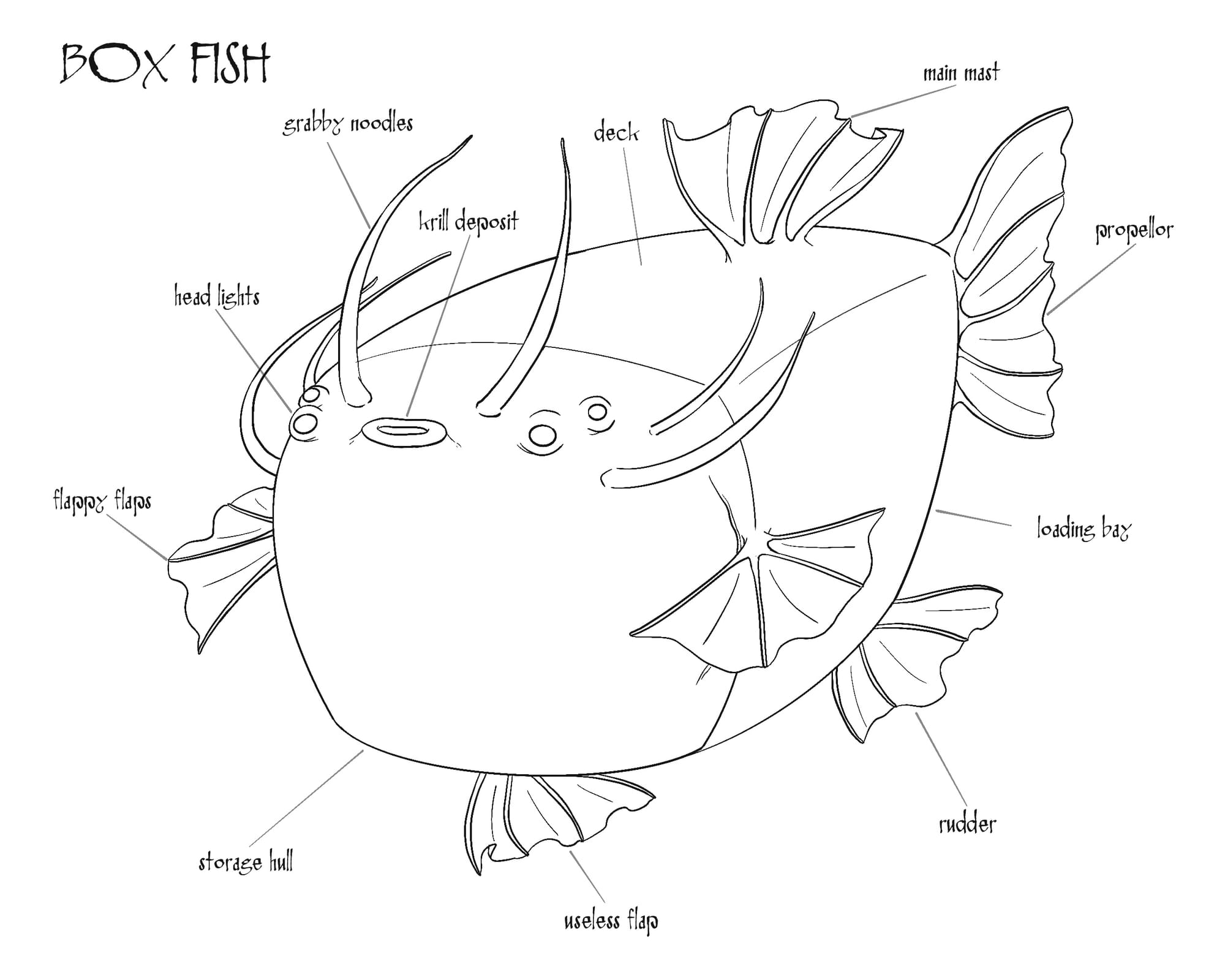
Box Fish are not as big as whales, but do come close in some cases. About ten feet high, six feet wide, and anywhere from 10 to 40 feet long, they have a squarish shape, nibble on sky krill, which they look for with four to five tiny little eyes, and an array of tendrils which are like a nostril turned inside out, which then deposit the krill into a very small mouth near the top. No one is sure how they float about the skies, as their skin is very tough, and there is little meat or fat on them to speak of. The name comes from their enormous box shaped skeleton, which holds a large empty compartment on the inside accessible through the very large anus. They can be trained and are sometimes used to ship goods from one place to another.
Wheelopede is a creature who lives on the old lines in the Tubes. They have through evolution given up their legs for wheels of iron, and their bodies have created segmented spaces for travelers along the wild rails. These rails have connected many strange places, but they are immune to the psychic disturbances, and protect their temporary inhabitants. They have tribes according to their lines, and will follow them to the letter. However they do not have hostility to the ones who want to switch lines to get where ever they are going. They have announcements at each terminal to let passengers know which line to exchange to. These creatures are found only in the underground, and are innocuous to those who catch their train.
The Wild Haggis are plump, meaty burrowing rodents who populate all regions of Airnea. They vary wildly in their shapes, sizes, and colors, but they all are unique in their cuteness, warm hides, and their deliciousness. These furry rodents bumble about the landscape on four legs. They tend to move in packs, and are often hunted for their succulent fatty meat, as well as their warm fuzzy pelts. There are those who keep them as pets, and can domesticated on farms, but are likely to escape if they hear “the call”. They have a strange relationship with daghorns in the wild, as daghorns are their most common predators. Usually the elder Haggis, the largest and most plump, will divert daghorns away from the pack by extending their necks and calling in high pitched throaty wails “Scotland the Brave”, it is a tune well recognized. You can tell this is about to happen if the haggis starts expanding in size, as it is taking in breath for “the call.” However, when threatened by anything other than daghorns, they will emit the call, which will summon their predators to stake claim on the pack and drive off all others, so hunt with vigilance. They are vegetarian, and have a digestional tract which when harvested will also serve as the most exquisite casing for sausages made of their fatty meats.
The Strandbeasts are creatures of the desert and coastlines, are composed entirely of a skeleton and sail, and are tended by the Strand Gnomes. Hitching a ride on a strand beast is a very safe way to cross a desert, if it can support you. The strand Gnomes will readily trade desert crystals for PVC pipe, plastic bottles, and fresh plastic wrap. Gnomes will constantly keep the Strandbeast in good health, allowing it to pitter-patter across the sands as it sees fit. The creature navigates of an intelligence of its own, despite having a brain, and is quite fortuitous.
Very Low Level Threats (except in large numbers)
Dorcs are related to Orcs, but Orcs would never admit it. They have normal voices (Gosh!) and live underground because they don’t like the sunlight. They make their homes near the Ancient Dead Malls where they gather their loot, usually Comic Books, VHS tapes and old electronics which they repurpose for watching reruns and skate tapes. They are creative and curious, and will only attack if they have enough numbers, and then it’s similar to being pelted by sponges. Despite their lack of muscle mass, they are incredibly difficult to hit, and can hide as well as halflings. They will help adventurers if it means they can find more loot, and know how to survive underground by scavenging sealed bags of Nachos and bottles of The Dew. They will work for prunes or a roll of quarters. As the Dead Mall is made safer, more Dorcs will start hanging out and working at the various store fronts. Dorc technicians are the equals of Druids and Gnomes in repurposing old tech into usable gadgets, which they will sell in boutique shops alongside collections of cool knives and decorative katanas, or custom skateboards and pogo sticks which they use to navigate the Underworld's sweet jumps. Gosh! Dorcs do not engage violently, they try to negotiate, distract, otherwise run away, last line of defense, fight like a villain. Dorcs admire other dorcs who learn the languages of men, elves, and dwarves, as they are better negotiators. Dorcs who do decide to fight as a team are extremely dangerous, do not get on their bad side. If they really don’t like you they will follow you around and make life difficult. As an ally they are steadfastly loyal to anyone who takes their defense. The name Dorcs is often mistaken to mean “Demi-Orc”, which is refuted by true Docs. They are Dorcs because they are “Adorcable”, which they will tell you with a mean face.
A Dorc who has survived the Backrooms will be forever changed, they will always have a haunted look, and will not speak. If you can get them to speak of what happened, through convincing or spell, they will tell you who they went in with, how the Shadow found them, captured the others, and how he escaped by going in the door marked “Storum”, and that the world unwound for a bit and they ended up at the entrance, and there was a massive cave with a million {Insert Anachronism Here} in it. After the story the Dorc will probably will have a breakdown, so take care of the little guy.
Thrillobites are adventurous beetles (or possibly crustaceans) who love a good time, which usually involves falling from great heights or rolling down steep inclines. They generally mean no harm, they just pop up at the wrong time and cause all kinds of havoc. Usually they can be found climbing cave walls reading Travel Magazines, and will go on great excursions to find many other places to jump off of or roll down. You can usually hear them coming from the growing “Weee” sound as they approach. Watch out, some have spikes!
Lightning Beetles will inhabit woods, caves, grottos, glow in the dark, and deliver a shock if you try to catch one. Swarms will deliver a lighting bolt if they perceive a threat. Queens are very large and can deliver a lighting bolt on their own.
Creeper Vines are a carnivorous plant, who trap their prey with venomous thorns which render the kill limp and unconscious, and are slowly digested by the roots. They will move slowly at first, and then attack with lighting speed. You can often spot them before you get close enough by identifying their clipped leaves, and the prickly sound as they move across the floor or wall.
Lugbugs are large beetles who can fling stones at high velocity at their prey. They don’t hunt large prey, but a swarm of them will unleash a hail of stones that will be a major inconvenience.
Barrowgoves are dark birds that hang around burial sites and croak. They are scavengers, clever, and deceitful. They will alert the dead to intruders, spy on the living, and deliver messages to necromancers. A flock will sometimes attack intruders, pecking and scratching at the eyes to blind the victim, then lead them to a precipice or deadly trap.
Momraths are large carnivorous rats, with long shaggy hair, and the ability to leap at their targets. They will swarm to take down larger foes, the leader going for the face, their fur obscuring vision as the others bite the ankles to take the victim down. They easily catch fire, and avoid it at all costs, and will drown in water.
Jermlaines, Bane-Midges, Jinxlings
Two variants, rat Jermlaines and toad Jermlains.
Description: Small warty men with tufts of hair all over, very dirty. Only about 2 feet tall full grown. Large noses, and beady eyes.
Habits: Prefer to hid than fight. Only active at night or in dark caves or swamps. Will attack in groups, prefer to ambush or trap victims. Territorial. Like shiny objects.
Hit Points: 3
Abilities: Speak with rats or toads, Keen Sense of Smell, Shapeshift forms: rock or lump of mud, large rat or toad. They can also skip across water if they start on land at a run.
Vulnerabilities: They are petrified when exposed to sunlight or immersed in water.
Lore: They say if you capture a Bane-Midge take one of their feet, they will be in your bondage for one action upon the return of their foot. When the foot is taken they will cry out a word, and as long as you keep the foot, no matter where you are, you can hold it in your left hand and say the word, and they will come to you to perform their action, once you have given their foot back. They are particularly stingy, and will only perform the action to the letter and then vanish.
Redcaps
Description: Small pale little men with wide faces, squinty eyes, and a bright red cap. They can easily be mistaken for a large mushroom. They are usually naked or wear a loincloth.
Habits: These are nasty little sprites that will haunt orchards, graveyards and abandoned houses and towers. Usually make noises and throw rocks or piss on passers by to scare them off. If they do not wish to fight, they will stand stock still and pose as mushrooms. The Red in their caps is from the blood of their victims.
Hit Points: 2
Abilities: They can emit a fine powder that will cause confusion, which can weaken their victims. If there are a large number of them, they can quickly use this to overwhelm a larger foe. Eventually the powder will render the victim unconscious and they will use the body as a food source like a fungus, rendering nothing but dirt and a skeleton. This is also how more redcaps are bred, and a place where they have taken over are considered lost causes.
Vulnerabilities: If you knock their cap off, they are effectively blind and cannot emit the powder. A gust of wind can also render a whole pack of them wriggling on the ground looking for their caps. If you cover your face with a damp cloth it will help ward off the effects of the powder. Fire and heat are also effective. Weaslepider are immune to the powder, so one Weaslepider can effectively destroy entire Redcap incursions.
Flits
Description: Tiny winged lizards who live in caves, similar to bats. They tend not to bother humans, but an angry or frightened swarm is highly dangerous and can knock over a full grown Human.
Habits: They primarily eat insects and small birds, and will leave larger prey well alone, unless you get near their nest. They will protect their eggs with a great ferocity until you depart the vicinity. Their nests are communal affairs so be prepared to deal with a large number.
Hit Points: 1
Abilities: They can fly and hover, which makes them difficult to hit. They attack in swarms, latch on to their victim with small hind claws and bite. Once they bite they take off again quickly.
Vulnerabilities: They dislike fire and rain, and tend to stay underground. A torch or a burst of water will disperse them. They are particularly vulnerable to any kind of electrical shock, which will spook them. Lighting is devastating to flits, as the electrical shock of that magnitude will quickly pass through the whole swarm (and anyone in the swarm).
Lore: It is said that they are the most diminutive relative to the mighty Dragon, and that anyone who has dragons blood upon them will cause flits to go into a kind of whimsical murmuration about the individual, and follow their commands.
Midgeflies are a constant nuisance throughout the Known Worlds. They come in a veriety of sizes, and can sting and cause all kinds of worry. They feed off anything rotten, including corpses, and will build hives in rotten wood and old trees. Some get as big as a fist, and can kill a man with their sting. The maggots are quite unpleasant but easily disposed of, unless there is a mother Midge about, who will, though small, attack with the ferocity of a grizzly boar.
Hitpoints: 1
Abilities: Sting, Quick, Swarm
Weaknesses: Smoke, Bug Spray, Water, Adhesives
Low Level Threats (Except in Large Numbers)
Borts
Description: Large flightless vampiric koala-bats
Habits: They live in caves and dark forests. They will wait in a tree or perch, and drop on their prey latch on with a venom tipped claw that will render the victim unable to move. Once they have their prey, they will drink their blood until sated and then climb back up to their perch. They can often get to be large as bucket and dangerous. They can walk on all fours, can easily climb, and will glide after falling.
Hit Points: 4
Abilities: Echo-location, venom claws, sharp teeth.
Vulnerabilities: Blind, sensitive to loud sounds which will confuse or incapacitate them for a moment. They make a “grick-grick” sound for echo-location which is quite distinct so they can be identified ahead of time. They cannot fly if landed on the ground, which makes them vulnerable for a moment as they get to their feet, so they will often attack in groups.
Froglings and Toadmen
In swamps and near streams, there often live tribes of amphibious goblins who resemble frogs and toads. They hatch eggs and guard them fiercely. They also collect treasures from travelers who go through their territory as a toll, and those who cannot pay are carefully considered as being edible, or asked to do something for the froglins. They are not generally not hostile unless provoked, and commonly fight with goblins and wood Elves over territory.
Hit Points: 3
Abilities: Swim, water archery, tongue lash, super jump, venom, hide in mud
Vulnerabilities: They are sensitive to extreme heat, cold, and dryness. Bad hearing.
Mid Level Threats (Except in Small Groups)
Porklings, Borlocs, and Swinelords
These goblin pig men will settle in nearly any place seen unfit by men or elves. They sleep and root in their own filth, have only the most basic of tool making abilities so they will often trade with creatures rather than fight. Porklings are excellent collectors of truffles, which is their main currency of trade. They will happily eat their quadrupedal cousins and anything else for that matter. They are not as large as orcs, but larger than most goblins, and will often take them as slaves. They can use melee weapons, spears and slings, but their hoof like fingers makes it nearly impossible to use bows.
Hit Points: 4
Abilities: Tusk Charge, Bite, Kick, Quick, Wiggly, Greasy
Vulnerabilities: Easily distracted by food and treasure, dimwitted, greedy, suspicious.
Gnolls, Jacklads, Hynies
These dogfaced hyena goblin types are deceitful, clever, untrustworthy, and cowardly by themselves. In groups they can be a terrifying menace. They hunt in groups, steal whatever they can find, and like to set things on fire. They can hunt and track by scent, and don’t go after larger prey unless they have three or more in their party. They can also use bows, and have a more developed tool craft than other goblins, often acting as smiths and armorers in goblin and orc settlements.
Hit Points: 4
Abilities: Track by Scent, Low-Light Vision, Advantage in Numbers, can lose sense of pain in a fight.
Weaknesses: Noses are sensitive, strong response to alphas, cowardly
The Purples are cave dwelling little men, dark purple in complexion, no visible eyes or mouth, but grasping hands and feet, and long tails that lead back into a crack or crevasse in the dungeon. They act as a unit, and the tail is actually an umbilical that leads back to the queen somewhere in the crevasse. They feed off anything that walks by, and are highly attracted to crystals. When they sense prey, they will try to creep up silently and grab a limb, or pounce and wrap their limbs about the prey like a large fist. Once grasped the umbilical will start pulling the prey back to the Queen at a rate of 1d6 meters per turn. If the victim is pulled into the crevasse, the last thing they will see is are two long row of iridescent eyes and teeth. Your only hope at that point is to detonate an explosive and hope it let's go. If you cut the umbilical, the Purple will die, but the queen will deploy two others in it's place. The only possible way to kill the Purples is by using explosives. Often it is better to run, as they can only get so far, and a queen will nest somewhere they can trap their prey.
A Gibberjabber is a fungus spirit which likes to talk to people. It is harmless, and a small clump will provide information about what has passed by. However, large infestations will create such a cacophony that will make it impossible to hear and alert creatures nearby of intruders. Goblins will often actively plant this fungus near the entrances of their lairs.
Snoks live in holes in caves walls and floors, a blind worm, and will grab a hold of prey as it passes by. A single snok can easily be defeated by pulling the head out and severing it to free the grabbed limb. However, a nest of snoks can tear their victim apart if they all attack at once.
Ickthits is an ooze that slithers through the dungeon like an eel, silently, and is quite dangerous in tight passages. It will use the rocky surface to brace itself and deliver a powerful lunge at prey. The ooze will dissolve metal and digest leather and flesh over time, but is very sticky, and will drag its prey tirelessly back to its lair, envelope it, and digest it. The Ickthits only needs to eat once a month, and does not grow larger than about 3 meters in diameter, but can stretch out to half a mile.
Fezeers are fire scarabs, that live in deep caves, often near hot magma. If they are cooled, they will fossilize quickly. But they will spew hot gasses from their abdomens as they scurry away. They get as large as grown mans fist.
Nasty Crabs are generally a nuisance, if not a deadly one. They are very large crabs that live underground in wet, watery, and damp caves, often in clusters. They have keen hearing through their exoskeleton, but they have no eyes. Instead of eyes, they have stalks with two hand shaped appendages that are constantly flipping you the bird. Occasionally they will grab something. But their main tool is their gigantic claws and their toothy maws. However their shells, although intimidating, are not as hard as you would expect, but only a direct headshot will do anything to take it down, everything else they can regenerate. If they feel they have been outmatched, they will sacrifice a limb to escape, usually one of the claws, which can fetch a bit of coin at a fish mongery.
Serious Level Threats
Bugmocks
These hairy apes are very dangerous predators who hunt in small groups of 2-5. They can wield weapons, collect treasures, but generally do not wear armor, as it restricts their anatomy, and they don’t know how to make any for themselves. They live in many different climates, adapting to the conditions in packs. They have the ability to petrify their enemies with fear if you try to stare them down, and if you are not reanimated you will die as a statue. A Bugmock that has petrified a creature will save it for later, and can reactivate the corpse as a zombie by either touching it, or hitting it with an object thrown at it, which will then fight to protect the Bugmock and its pack. Bugmocks are also known to fling their scat or fart in your general direction as a distraction when wounded. The stench will cause nausea and confusion.
Jabberwock is a large winged beast, with a long neck, long limbs, and a lashing tail which will attack in any direction. Each Jabberwock can attack six times on each turn, unless the limb is cleaved. Taking the head will kill the beast, but it’s head is very quick. You’ll need a Vorpal Sword in hand.
Bandersnatch - this creature is unseen until it’s too late. They inhabit abandoned buildings with the roof intact, but dislike caves and open sky. Some will travel the woods on the darkest nights. Light will instantly banish them. No one has ever seen what one looks like.
A Jubjub bird or Hookbeak, is a large flightless bird that nests in caves. It hunts by stealth, but is able to mimic the voices of previous victims, which they use to lure new prey to it, imitating their cries for help. The beak can grab it’s victim and dash them against the rocks.
The Gnarles are grumpy roots that wander dungeons in search of sunlight. If they find a patch, they will set about growing a tree, and become sedentary. But prior to that, they will knock about anything that gets in their way. They grow from the seeds of the Gnarle Tree, which are often ingested by goblins and scattered in deeper parts of the dungeon.
Grabberfrost is a snow beast that hides in drifts and grabs prey with it’s 6 limbs. It freezes its prey with ice breath and stores it for later in its lair.
Swampmaw is a worm that dwells in swamps with it’s mouth just below the surface. It waits for passing prey to gobble it down. Will leave a ring of bubbles on the surface.
Balloonfer Fish live in a variety of environments. A larger and more aggressive variety of the Bubblefish, they are aerial aquatic beasts which have the capacity to inflate themselves to remain buoyant in either air or water. These fish have spiky carapaces which only threaten when inflated. Once inflated they can swim against an intended target for 1d6 damage. But if you happen to be in the range of their tremendous jaws, they do 3d8 damage, and ignore armor. Their typical way to hunt is to float about inflated, their tiny hands and feet appear nothing more than webbed fins on their body. Once they target prey, they quickly dispel the air from their fishy insides, often accelerating to the target, and once deflated, the limbs become large beefy arms which they use to walk across the floor to grab a quick snack. They have no hind legs, just a short fishy tail. But while inflated, they can easily be discouraged by a smart poke against their inflated flesh, mindful that you can get past the poisonous spikes.
Bowel Hare will find a nest to protect their young, which are about the size of an average human. Bowel Hare’s have large bellies and long ears, strong hind limbs that will kick and stomp. An Adult Bowel Hare on it’s hind legs will reach 9-10 feet tall, and have long sharp canines that are used to root for grubs and truffles. When threatened, they will attack over far distance as if it were near, and try and pin down the threat and bite it’s throat or stomp the living daylights out. If they spy a threat at a distance, they will launch their spherical scat bombs from their anus at high velocity, doing d6 damage per skat bomb, and leaving a very smelly mess.
Broccoli are sentient tree like plants that are highly aggressive and want to be eaten. It is the only way they can reproduce. When a large enough life form, or an equivalent number of smaller life forms are in the presence of a Broccoli, and make enough noise, they will wake up and start stomping about crying forth in deep voices “We are Broccoli! I want someone to eat me!” and will pursue until eaten. Now a caravan in a Broccoli forest is in great danger and must proceed quietly. However, a large creature, such as a Giant or Kaiju will be able to dispatch the threat quite deliciously. They are more appealing if seasoned, so prepare those cumin grenades!
High Level Threats
Grizzly Boars are huge and dangerous, with hoofed hind legs and clawed fore legs and grow to be up to 9 feet standing, and 6 feet on all fours. Not to be confused with Grizzly Bears which live in the mountains, Grizzly Boars live in lowlands, swamps, and deep in forests and dry deserts. They prefer heat as they have very fine fur.
Hit Points: 10-20
Snagora or Snow Sloth are a big beasty with six limbs and grow to 12 to 20 feet long full grown. Despite there being wild species that are aggressive if their young are encroached upon (think grizzly bear), they can be domesticated, and are used by Frost Dwarves as steads in battle.
Hit Points 10-20
Abilities: Immune to Cold, Claw, Claw, Bite, Very Thick Hide
Weaknesses: Sensitive to fire, Slower creatures than Ostrix or horses
Fihrblix or the Jungle Fur Serpent may look cuddly at first, they have a viciously large set of mandibles underneath the fuzz. They are apex predators and should be avoided like the Gargantula. They can grow up to 15 feet long, and some legendary beasts were reported even larger. They will often just reveal their head, making a mewing sound that resembles a house cat or kitten. The prey might mistake it for a pet or a quick meal, only to become the meal themselves. They strike fast, so if you hear a kitten mewing in the wild jungle or see the head of one peeking down from a tree, best get the hell away quick, or draw your dagger, because a sword will be too late. Hatchets and machetes are just about the only thing effective against it in battle, or if you are lucky enough to ram your shield in it’s mouth and avoid the venomous fangs, a pick ax to the head a few times will put it down eventually. A well placed acid tipped arrow or dagger will partly immobilize it, and it will take a few to effectively slow it down. Natives will use a barbed spear, and when timed correctly will impale the head through the mouth when the beast strikes. After removing the venom glands, a full sized Fihrblix will feed a whole tribe for the night with leftovers for the trek afterward. If you do get bitten, the venomous toxin will start to take over as it coils its fuzziness around you, and rather than pain, you will start to feel euphoria as if you are being snuggled by a million kittens, and your eventual suffocation will feel like being blissfully whisked away to sleep... forever… in a snuggly pile of kittens.
Hitpoints 10-20
Gargantulas
Three Varieties: Small, Large, Ancient.
Description: Giant cave spiders, small and large ones will be slightly hairy, with stripes or patterns that often will allow them to blend in. Small will be around 2-4 feet in diameter with 8 legs, Large can be up to 8 feet with 10 legs, and Ancient can be up to 10 feet in diameter with 12 legs. Ancients are devoid of hair and have a leathery carapace. They have a stinger on one end and mandibles on the other.
Habits: The make their webs in caves, but they are often on the ground or on walls, and so you can walk right into them. The substance is slightly sticky, but it’s the entanglement that will get you caught. A knife or blade can easily cut through, and fire will quickly destroy a web. A Gargantula will only attack once they perceive their prey to be caught, and will use the venom to incapacitate, and then wrap up for food later. They will perch on the ceiling or wall opposite their web. You can often avoid a confrontation with a gargantula if you have a torch. Burning the web will not provoke it, as they do not like fire or light, and will often move to escape or hide. However there are exceptions, if they have food stashed in the web, they may act to protect it, either by pulling the wrapped victims into their hole or by trying to douse the flame with a venom spray. The spray will be much more slow acting then the sting, so you have time to get away or attack.
The other exception, and this is important, is if it has an egg sack in the web nearby and that they will viciously defend like a mother grizzly her cub. If you are going to burn a Gargantula web, check to see if there are egg sacks nearby, they are slightly irredecent. You will almost never encounter more than one Gargantula in an area as they are extremely territorial.
Small Gargantulas may be found in clusters, and will usually only eat small prey, but will act as a group if they feel threatened, you will see the mass quiver when this happens. In a swarm they can only be countered by extreme wind, water, fire or lightning. They do move slow however and can be easily outrun. As they grow they will disperse to all corners of Known realms by climbing to the tops of tall mountains, weaving little parachutes and catch a ride on the wind. It can be unsettling to have a small gargantula drop in on a tea party.
Large Gargantulas are territorial, and have grown old enough to lay an egg sack, which they will protect with grizzly might. However, their maternal shift along with their new isolation will sometimes cause a mother Gargantula to speak out to those in the vicinity to see if they pose a threat. If the Gargantula can be appeased, either through tribute or performing a request, they will not bother you. Sometimes the Mother will need assistance relocating their eggs to a more protected area beyond the patrols of hostiles. If this task is done and the egg sack and mother arrive safely to the new location, the Mother will weave her dreams into the egg sack, and once this is done, she will curl up and die very quickly. The the young of that egg sack will remember the characters at a later time, will not be hostile, but murmur their names, and will protect them when they can, and show them safe passage.
Ancient Gargantulas are those who have had their egg sacks destroyed by another predator, and have become hateful, hungry, and filled with bottomless sadness. They will attack anyone who encroaches their territory on sight. They are considered Epic Level Threats.
Hitpoints: 1 for infants, 6 for small, 10 for Large, 20 for Ancient.
Abilities: Claws on each front leg, 2 attacks for small, 4 for large, 6 for ancient. Mandibles, Venom Stinger at close range. Venom Spray. Web. Immune to poisons
Vulnerabilities: Fire is your best option. Is extremely vulnerable if flipped over or on slippery surfaces. A stab to it’s underbelly will do double damage, unless it is an Ancient which will have a hardened underbelly.
Note on Ancient Gargantulas: These are considered legendary and will have massive webs that can encompass entire cave complexes. You will hear the sound the faint sound of weeping throughout the entire area, but if it stops, you are in danger.
Quatl, or the Feathered Serpent, a winged snake bird which radiates luminescent light in all directions. These fabulous creatures have udders which can be milked for their narcotic Quatl-milk, which sends the consumer into rapture. These creatures have two weaknesses, the illumination of a crystal, and they love to dance! They will eat you if neither of these things are present, so it is wise to have a Boombox or a drum with you. Their feathered tails will also be lashed out to tickle their prey, sending it into a fit of giggles, during which you are highly vulnerable. However, not only do they like to dance, they like to watch other creatures dance, and if you can impress a Quatl with your dancing they will not eat you but be subdued and hypnotized by your magic moves. If you can blow them away with your atomic feet, they will begin to dance with you. Music of a high intensity will send the Quatl into rapturous motion spherical motion and they will begin to emit shafts of lite swirling in all directions. After a while of this, music of low intensity will put them to sleep.
The Morkun dwell in deep root forest, growing moss on their backs, living in small tribes. They often war with each other, but it is a silent war. They have venomous maws, which incapacitate their prey, which they return to the tribe for communal feasting. No one is too sure what they look like under their moss, but their limbs are strong and they hunt in packs, silently. They do have a peculiar scent which can give them away.
Horriblix is a blind serpent of the deep, and will turn stone to sand in the places where it dwells. It sprouts up from beneath to catch its prey and drags them under to devour them. Some say they live in nests, others that a single serpent sprouts many heads.
Scythy Toads dwell in swamps, and have hooks on the ends of their tongues to catch large prey. They are twice the size of a man, sometimes larger. When provoked they rize above the water, and long spikes on their back stand up presenting a fearsome foe. They don’t move fast, but their tongues are viperlike.
Gronge are stoney creatures that pass through stone like ghosts. Magical in nature, they defend sacred sites from trespassers. They usually stay close to the stone walls, and strike out from them before descending back into the rock. They tend to avoid striking from floors or ceilings, as it can disorient them, and will only do so in groups when they have an advantage. They can be reasoned with, but only to the extent that they do not break their oath of protection. They will often give warning in the shape of large stone faces which form in the rock before a sacred site.
Gorecat has one large fang that protrudes up from its lower jaw, and will ram their prey with it to gore it. They will then hold it with their upper fangs while it dashes them against the rock or trees. Their front paws have razor sharp claws, their hind legs sport sturdy hooves to propel them forward. They also have a thick skull making them immune to head attacks, but their belly is soft and vulnerable
Slipperwills are a kind of fungus which grows in moist areas of dungeons. They produce a most alluring sound which will draw a distracted adventurer down toward their slippery lair, usually on a slope, where they will fall on the wet rock and knock themselves unconscious. Then the fungus acts quickly to cover the body and begin digesting it.
Wryno are only dangerous if provoked, and will be extremely helpful if befriended. They do not like fire, it is not dangerous to them, they just don’t like it. Lamp light is preferred, and they look at it in wonderment. Any creature with a lamp has a +2 to charm a Wryno. Wryno’s also like prunes. They manage to get through the smallest spaces in a cave system, and can walk on walls and ceilings, and will make wry comments under its breath as it leads the adventurers. They will lead adventurers to the exit of the dungeon where they will encourage them to go out. If the adventurers do not, the Wryno will become vexed and try to get them to leave. If that fails, it becomes angry.
Mauliphaunt live only in the wide open caves of Gargantua. Though they are omnivores, and will grab prey by their trunks and crack their skulls with their jaws and suck up their brains which are added to the hive mind. They have telepathic powers and can communicate with sentient beings. They never forget. They look much like elephants except they have small ears and short fur on their backs. They also like prunes. Very small creatures, like halflings, scare the dickens out of them, and if they cannot stomp them, they will run.
Broncoltrix is the great horned foul of the cliffs of Gargantua. Only the males have horns, and protect their brood of females with ferocity. They fight with horn, claw and beak, and can glide down on their targets from nests above. They don’t eat for food, they survive off wild grains in the crags. Once a threat has been dealt with they leave it for the scavengers.
Saberflies live in dank pools deep underground. They have a very short lifespan of only a few days. They live to protect their queen who will deposit her eggs into a fresh pool. The eggs float at the edge of the water, and when they enter metamorphosis, they rise like insect pillars from the water often very quickly. If this is witnessed, it is best to leave immediately.
Once dry they stand as tall as a man with long iridescent wings. Their bodies and limbs are spindly, but their mandibles are long like a saber, which they will use to strike the heart and suck the blood dry from their prey, which they will then feed to their new queen as they make their way to a new pool. They are fast and deadly, and can drain a man's blood in under a minute. Once full they are slower, so other flies will guard them as they follow their queen. Where they cannot fly they crawl, and will hide in narrow passages to assail passers-by.
Capitulungus (Luocha) are not of this world. They are demons manifest as twisted men with enormous heads and mouths that replace the torso, their abnormally long arms and fiercely strong legs are obfuscated by robes. They wield massive weapons. Their mouth can swallow an average sized human whole, their eyes are wild and terrifying. The face almost looks like a mask, covering something even more terrifying. They look feeble at first, their head swaying under its own weight and limbs moving oddly, as if they are unaccustomed to walking, but when they are ready to fight they are a terror to behold, striking quickly to dispatch their prey and consume the spoils. When they speak they have a low rumbling voice, but their laugh can cause madness in common men. They are seen at night with a stick across their shoulders carrying two pots suspended by ropes. What are in those pots is anyone’s guess.
The Graakla are 6 legged blind lizard forms, with an acid vapor breath weapon. They live in caves and deep forests. They are feared by Elves. Graakla can climb along surfaces and fight in all directions. They often fight with Daghorns over hunting grounds, and it’s a fairly even fight. Graakla are as tall as human when standing on hind legs when full grown. At birth they are the size of a puppy. In large numbers, the Graaklings are as formidable as their parents are. The males have a single craggy horn that grows straight from their forehead. They can move on 2, 4, and 6 legs to go from speed to power fluidly.
The Ronin (Roamers) are cousins to the Urubon, but un-creative. They are autonomous drones with a programed algorithm for a brain, in the form of a crystal. They have a specific mission to defend a certain area. Once triggered they will activate and not stop until they have eliminated the target, or run out of power. These machines are very efficient at eliminating threats, particularly adventurers. Ronin operate as a system of drones with different functions. There is always a signal generator and a power source. The Ronin can be hacked if the signal is hijacked.
Epic Level Threats and Inconveniences
Giant Beasts or Kaiju
All Giants have survived from the ancient world, and are as mysterious as they are terrible. These can be extremely large versions of either beasts or men. Hill Giants for example,which look less like men and more like a rocky hill with a face and arms and legs in the shape of a gorilla. Their brethren, the Tree Giants have not been seen in the Known Continents, though one is said to dwell deep in the Sylvian Forests of Bergosia, and is protected by the Elves of the Moon. There are many kinds of Giants which wander the Wildlands. Most of the man shaped ones were destroyed in the Giant Wars a thousand years ago, making the beast kind more numerous.
Why are there so few man shaped Giants? The thing about giants is that they eat so much. Giants generally do not eat people, there is too much trouble for too little meat. Generally, they find us cute, and will keep humans, elves, dwarves as pets. But despite some cannibalistic behaviors of some giants, horrible wretches as considered by most giants, they generally eat much, much more than a territory can provide. Many starve and turn to stone.
Which is a problem because giants are not agricultural people, nor do they herd livestock. They are by and large hunter gathers and don't commonly have any consideration of law and property rights. So they eat what they find, much to a community's dismay. A tribe of giants, which means 1 to 4, can destroy a years worth of crops, livestock, and preserves overnight, and a community that does not have the protection of the king and his army will not fair well in these circumstances. Hence, humans have come to live in city states surrounded by massive walls in concentric circles radiating from a central mountain Citadel.
The exception are the colossal slumbering Cloud Giants, who have stood in place for millennia, their heads lost amid the clouds, can only be viewed from airship, at a safe distance. They resemble massive statues, and are not to be disturbed, under orders from the Church of Ademos.
Alien Things
Earloblians are a being from another dimension with strange powers of hearing. They consist of a single eyeless head with a gaping maw, which is supported by many tendril stocks which weave beneath it, at the tip is a human sized ear. It listens constantly, and has been known to hear people's thoughts, but they are consummate liars. Their power is psychic, and will make claims of knowing it’s prisoner’s secrets, and on a failed Wisdom check, the character will believe whatever the Earlobian says. Rolling a one on this check means the Earlobian has actually learned a true secret. Their weakness is music, and on a successful performance roll they will lose concentration. On five successful performance checks, the Earlobian will become charmed with the group, and want to keep them as pets. On 20 successful checks the Earlobian falls asleep into a deep slumber. However the first failed check will disturb the Earlobian and they will mock you, and you will have to begin again. A 1 rolled means the Earlobian becomes enraged at what he hears, and will begin taunting with more severity. They cannot be harmed by normal weapons, any tendril cut will sprout two more with ears. Every round they can attack with D4 ears spitting earwax at the characters which will plaster them to the floor. The only way to banish an Earlobian is to learn and speak it’s true name, it’s deepest secret. This can be done as Earlobians love a challenge of riddles, and their prideful nature will always leave clues about their true name. Earloblians also get high off the sound of Farts. They absolutely adore them. One of the ways an Earlobian ensnares its prey, is that it will act as a ally to the players, get them well fed and knock out drunk, get high on all their farts and lay out it's master plans which will make its way into the victims feeble minds. The next day, the Earloblian have 1d14 brainwashed sleeper agents out to its bidding, unknown to victims. They will often do things without thinking about it, which will explain all the snacks. Some Earloblians get so worked up on the sound of farts that they will sprout a baby Earloblian, whom they will instantly fall in love with, the little handsome man. They may abandon the sleeper agents at this point, and also anyone who wakes up in the middle of an Earloblian’s fart night out, they can easily escape with the other players, just sayin’. The existence of the Earloblian is publicly denounced by the Church of Ademos.
Followers of Lobe are a cult who have fallen under the sway of the Earloblian. They have made their way into all sectors of the Church of Ademos. They are followers of an Earloblian (is there just one? Many? Who knows!) and disguise themselves as followers of Saint Lobe, a minor saint who had the misfortune of having a suitable name for this band of deviants, and he's long dead and cannot protest. Currently they are highly active in Church, giving small porcelain ears to important people as a keepsake. They say that Saint Lobe will always hear one’s prayers, and whole households will offer prayers and confessions to the porcelain ear. It is in fact the psychic end of an Earloblian Tendril, making its way into the houses of all members of government and state. The Followers of Lobe have been known to answer people’s prayers in unusual ways, and also to know their darkest secrets. Many members of the sect are completely unaware that they are doing the bidding of an alien being. Only the Initiated are allowed to commune with “The All Listening One.”
Snailgantus is a creature of the deep forest, and is not so much a threat as an Epic Inconvenience. It only digests plant matter, and anything else it absorbs as it slimes its way through the woods just gets passed out the other end after about 8 to 10 days. Some say you can survive the whole journey, and that the digestive tract of Snailgantus is a portal to other worlds and dimensions.
Waldogons are red and white creatures who imprint themselves on the surfaces of objects and hide in a crowd to observe humanity. If you are able to draw a circle around one, they will grant you a wish.
The Babas and the Yagas
Are two and the same. One is a Creature of Overbearing Love, the other is a Creature of Overbearing Debauchery. They live among the folk at a distance, and will often setup very convenient Bed and Breakfasts, Baths and Massage Parlors in unusual places. They like to keep humans as pets. The Nohmish are very aware of what they are and are immune to their curses, while the Dwarves are suspicious but can be won over with fine food. They each have a sister of the other kind, and are not on speaking terms, and will use their "pets" to send messages to the other, often over vast distances, usually about some petty dispute. They will grant boons for your journey to help you along, but once caught you are forever their thrall. If you stray too far from conveying the message, things start going badly, and all your rolls begin to take minuses, stacking each day until you start making your way to the sister. You just need to be traveling in her general direction. The only way to free yourself from their curse is to get them to move in together and make a home. After that you are free and they just have to work it out.
Denizens of the Deep Sky
The Sand Kraken is an octopod that has grown around a Benoist crystal and can float above the sands to feast on desert clams, bottlefish, and giant star squid. Most are 4 to 6 meters in diameter. There is said to be a Legendary Great Kraken that is a full league in size. They guard their hunting grounds, and will be a general nuisance to anyone who trespasses. Their tentacles can deliver wallop, 3d6 stun damage, and they can also catch and fling their foes d10 meters in the air (apply falling damage). They can also spit ink to blind you. If they catch you stealing from their hunting grounds they will try and bit a finger off. They can quickly change color and shape to blend into their surroundings, so they are incredibly hard to fight. However, if you offer them a shoe, or a boot, they will let you pass without harm. You can do this eight times, and once they have enough shoes, they will be your friend, and join you on your quest, just keep track of their shoes, if they loose one, they will not stop looking until they find it. If you find them a hat and cane, they will perform tap numbers from time to time, and eventually join the circus.
Cloud Kalamari are massive Squid that dwell in the skies of Gargantua. Also grown around Benoist crystals, they are sometimes hunted, for their crystals are said to have heightened properties, and are strong enough to power airships. They are also delicious, and deadly. They range from 10-300 meters in length. The smaller ones can easily crush an airship if it's threatening, the larger can consume an airship whole. Their digestive system is said to be a pocket dimension, but that might just be sailor's tales.
Gemely Fish have a large, mushroom shaped body around a crystal heart, with long tendrils that descend from its underside. They can be found in many different sizes, ranging from 5 to 100 meters in diameter. They will usually not bother anything approximately their size or larger, but will sting if you get too close. They will feed on anything small enough they can grab with their tendril and fit in their (relatively) tiny mouth. Larger ones have been known to swallow whole ships, and it is also said that inside one, there is a whole city of people living in crashed ships who grow mushrooms under the glow of it’s crystal heart.
Brontomagnus is a creature of legend, spanning leagues, with a long neck, bulbous body and four mighty fins. They say there are cities of Kyrull that live on its back, and it eats small islands for lunch.
Aborosaurs of Gargantua
Treesaurus Rex is an arboreal mega reptile that dwells in the forests of Frume in Gargantua. They are gentle beasts, lumbering from one area to the next to get the best sunlight. But woe be unto him to shake an ax at such a creature. They are bipedal, and can easily climb to higher mountain regions. They will crush you in their wooden toothy maws.
Treesaratops is another arboreal species which dwells in the flatter areas of Frume, is quadrupedal and has a deadly charge attack.
Shrubasaurus has a long hedge of neatly pruned bushes down its back which it manages with great care and tenacity for breeding purposes. They can be tamed if you agree to help it manage its shrubbery, and will carry you through dangerous areas. They have a sharp snapping beak and can do incredible damage by ramming with their incredibly thick skull, even breaking rock. But the real danger is getting whacked with the tail end of their thagomizer.
Dragön of Ancient World
These creatures of the age of myth do not resemble the flying reptiles of other realms. These creatures of the weird are said to be created by the Wizards in their great Weirding war. Others say the Dragön predate the wizards, and were in fact their creators. Dragöns are elemental attuned, are psychically empowered, and terrifying to behold. No visible eyes, mouths that open like a befanged flower, and heads a mass of undulating horns and spikes. Some have wings, some tentacles, some writhe like a serpent or creep like a centipede. All are gargantuan. Ancient Eldar Dragons can psychically manifest a creature that looks human, and will pass among humans and influence them from afar. They love great treasure hordes and seek to possess them, but more so they love admiration, and flattery.
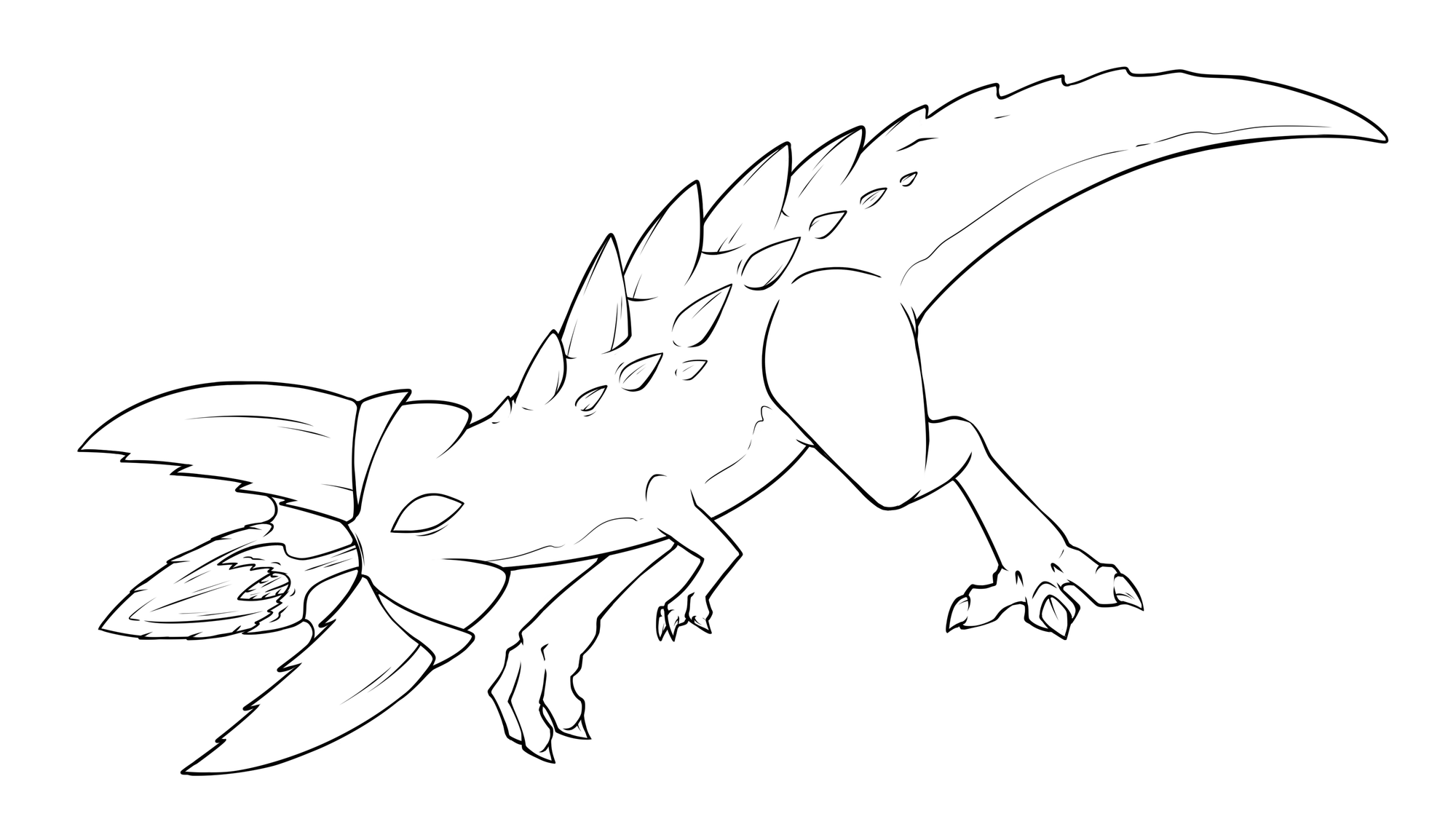
Daghorns are the smallest of dragons, anywhere from 4-6 meters in length, have 3-9 dangerous horns projecting from their heads, run on two legs and have tiny useless wings. They often hunt in pairs, will ram and pin their prey with the horns, and proceed with disemboweling with their toothy maws which have a pharyngeal jaw, which can also unhinge to swallow it's prey whole. It's a very messy affair. Females will have spitting sacks which will deploy either acid, napalm, liquid fluorocarbons, or a petralant depending on the breed. Some have even weirder defenses to protect their eggs. They will nest in caves, in proximity to available prey. They will feed primarily on larger animals (bruteox, muskaroos, goberds) and not actively hunt humans. However, they often nest near enough to human settlements to ravage their livestock. The Nohmish are vulnerable being preyed upon, particularly wood elves, as the Daghorn has penchant for their crystal hearts, which can cause mutations in the animals. Dwarven settlements are also at risks, particularly their burrowhog farms, and Daghorns are not shy about hunting dwarves. Daghorns can be found anywhere in the wild, often too close to settlements leading to frequent conflicts. The only way to stop them is to find the female nest, kill her and all the eggs, and the whole pack will defend their nests ferociously.
They are not easy to take down, but not impossible with a large group. Their horns are used to make a variety of things, like drinking vessels, helmet decoration, and pipes. Daghorns typically prey on Woolybugs, preferring to swallow them whole. However, they tend to prefer shorn Woolybugs, as the fur will get twisted up in knots during digestion and they’ll scat sweaters for miles. You can clean the sweater if you have the right soap, and it won’t smell too bad, and will keep you warm. If you find a neatly knit but filthy, smelly sweater in the woods, chances are, you are on the trail of a Daghorn. At the front you have to deal with their pointy horns and long toothed jaws. From the back, their farts are the most noxious, with an odor which can knock out a full grown man when taken directly to the face. Most deadly is the fearsome Fire-Farting Daghorn. Beware when it stands on its forelegs and flips their tail over. Run away!
- Flaming Fecal bombs
- Napalm diarrea
- Acid belch
Wyrm
Unlike Dragöns, these creatures are found in caves and on mountain tops, and also are called as their mythic counterparts under the common name: dragons. These creatures have only tiny limbs along their serpentine bodies, and range in size from that of an Ostrix to the size of a Hill Giant. They do not speak, have a multitude of eyes, a dangerous maw, and have crystal hearts of Yog. They are rare, but not so rare that they can be hunted. These creatures burrow through rock and soil. This type of Dragön, like their Elder cousins, does have a dangerous breath weapon.
Wyverns
These beasts are very common among the peaks and can navigate the Deep Sky. There are many varieties, but come in two distinct breeds, Sky Horse and Fell Wing. The Sky Horse variety is less aggressive than their cousins, and can even be domesticated. They do eat meat, but also enjoy sweet fruits and veggies, and can be plied with prunes. The Fell Wing variety are predators, will hunt all manner of beast, including its cousins, and will often have a breath weapon.
Horrors of the Deep
Mimicrus are what happens to buried treasure when blood has been spilt on it and foul magic was involved. Basically someone died over greed, and the Demovoss sets in, begins changing the Lockbox into a most vile horror, a creature who feeds on the victims greed.
Demov is a spirit that has been so corrupted in life, that they persist as a being of twisted malevolence in the spirit world, and seeks to have themselves summoned back into existence by the living, forming cults around themselves, often pretending to be from the ancient world, but actually just a nasty old wizard who refuses to die.
Gooblyguk is any kind of slime mold corrupted by Demov, and will feed on other creatures. There is a limit to how large they can get, as they eventually cannot support their own weight, and so break off into smaller Gooblyguks. However there are creatures of the deep who feed on such nasty creatures, and become corrupted themselves. Some Gooblyguks are not made of Demov, and are curious in nature, having a variety of benign yet strange properties.
T̛̤̰̱̥̝̳̹̰̽̃̒̍̀͡͡ĥ̬̦̗͚̃͒̆͌ͅe̡̛̮͈̹̥͇͙͐̎̍̑̀͝ ̖̟̲͋̉͠B̡̳̏͒͐͢a̬͒͋͟ç̗̫͕̠̰̭͍̍͆̎̍͛̍͋͞k̡͎̙͕̥̯͖͆̑̊͐͋̔͘͟͝r̬͍̮̙̃̂͂̅o̪̤̞͉̬̠̖̍́̇͒͂͡͡õ͓̼͍̤͛̃͒m̛̙̥̝̯̉͛̊͋͢s̝̟̒͠
Plastic Men - All products that survived the Kockup are wrapped in plastic, either plyfilm that is heat sealed or clamshell. As products are unwrapped and the plastic is discarded, it can build up and form a sentient mass, roughly cephalized, which will roam the T̛̤̰̱̥̝̳̹̰̽̃̒̍̀͡͡ĥ̬̦̗͚̃͒̆͌ͅe̡̛̮͈̹̥͇͙͐̎̍̑̀͝ ̖̟̲͋̉͠B̡̳̏͒͐͢a̬͒͋͟ç̗̫͕̠̰̭͍̍͆̎̍͛̍͋͞k̡͎̙͕̥̯͖͆̑̊͐͋̔͘͟͝r̬͍̮̙̃̂͂̅o̪̤̞͉̬̠̖̍́̇͒͂͡͡õ͓̼͍̤͛̃͒m̛̙̥̝̯̉͛̊͋͢s̝̟̒͠. All plastic men will attempt to “wrap-up” trespassers. Their tentril limbs will attack at Near Distance. Attacks will grapple their victim, and each turn the difficulty of breaking free will get more difficult until they are “wrapped-up”. Nobody knows where such “wrapped-up” individuals go. Attempts to dismember a Plastic Man will only be temporary, as the parts will reassemble themselves in d4 turns. Plastic Men do not like disinfectant spray or isopropyl alcohol, and they can be chased away using these items. Plastic Men will be burned by acetone, and do not like fire. Tetrahydrofuran (THF) is the most universal and common solvent for many plastics. Plastic men are drawn to radio signals and recording devices, and very much enjoy music, particularly Ragtime.
Methods of Dispatching Prey or Threat
- Swallowing Whole
- Chewing
- Dismemberment and Chewing
- Dashing to bits and Chewing
- Digesting and Slurping
- Crushing and Swallowing whole
- Disintegration
- Draining
- Incapacitation
- Exhaustion
- Wounding
- Fear
Weapons
- Teeth
- Claws
- Tails
- Stomp
- Crush
- Pummel
- Capture
- Strangle
- Drown
- Engulf (Glue, Web, Absorb, Fire, Water, etc)
- Tentacles/Pseudopods
- Goar (Tail, Horns, etc)
Mind and Magic Effects
- Disorientation
- Scream
- Smell
- Projectile
- Venom
- Gas
- Psychedelic
- Petrify
- Camouflage
- Mimicry
- Hive Mind
- Enchant
Unusual Movement
- Climb Walls
- Weird Speed
- Dodge
- Parry
- Dig
- Jump
- Hide
- Lunge
- Trample
- Swing
- Wobble
- Scuttle
Unusual Senses
- Vision
- Smell
- Hearing
- Touch
- Taste
- Tremorsense
- Air Pressure
- Light Changes
- Radio Waves
- Heat
- Sonar
- Psychic
Unusual Defenses
- Carapace
- Hardened Flesh
- Spikes
- Reflexes
- Grappling
- Targeting
- Obfuscation (camouflage, smoke, fog, shadow, etc.)
- Bioluminescence
- Stink/Spray
- Morphoflex (change shape, spread fins or scales)
- Pushback
- Phase
Unusual Weaknesses
- Fire
- Water
- Grappling
- Dust
- Acid
- Iron
- Silver
- Wood
- Air
- Poison
- Disorientation
- Light
Location
- Woodlands
- Plains
- Cliffs
- Mountains
- Swamps
- Deserts
- Coasts
- Sea
- Sky
- Caves
- Underground
- Grottos
Common Modes of Transport
- D6 x 2 legs
- 2 or 4 legs
- Wings
- Slither
- Burrow
- Waddle
- Scuttle
- Clamber
- Bore
- Crawl
- Glide
- Clamor